The science of role models, the power of professional networks, and the importance of equal opportunity.
Do we still need conferences just for women?
Since the Grace Hopper Celebration was canceled, I've heard that question more than once. Some women are asking it, too. Perhaps, they suggest, we're creating separation when we should be bringing women and men together.
I don't want to have to choose. I want both.
The cancellation of the Grace Hopper Celebration is deeply upsetting. As co-founder of the Day of Shecurity conference, I know what it takes to bring people together to share knowledge, build relationships, and advance professionally. I also know how much harder it has become to secure the financial support necessary to make these opportunities possible.
Over the past two years, the environment surrounding diversity, equity, and inclusion has changed dramatically. Many companies have become increasingly cautious about publicly supporting DEI initiatives, including conferences focused on women's advancement.
Grace Hopper's organizers report that registrations and sponsorship commitments fell far below what was necessary to fund the conference. They haven't identified a single cause for that decline. Yet the broader retreat from DEI initiatives is a reality that organizations supporting women's advancement cannot ignore.
We can learn from people of every gender, background, and experience. We can also create opportunities for women to learn from women, particularly in industries where women remain underrepresented.
Women already have substantial opportunities to learn from men. I want women to have equally meaningful opportunities to learn from other women.
This is about expanding opportunities for everyone.
Think about the last conference you attended. How many of the speakers shared your background, your path, or your gender? If the answer was most of them, you had something you may not have noticed: a full day of people you could picture yourself becoming.
That's one of two important, research-supported reasons women's conferences deserve our continued attention: the science of learning from role models and the power of professional networks.
1. The Science of Learning From Role Models and Building Confidence
One of the fundamental ways human beings learn is by observing other people.
Psychologist Albert Bandura established the principle of observational learning: we acquire knowledge, behaviors, and skills by watching others.
We watch how people solve problems, make decisions, communicate, lead, negotiate, and navigate challenges. We learn from their actions and outcomes, and we can use what we observe to guide our own behavior.
This type of learning can be particularly powerful when the person we're observing is someone we identify with. Seeing someone we relate to succeed can strengthen our belief that we can succeed, too.
Psychologists refer to our belief in our own capabilities as self-efficacy.
Role models are most effective at motivating people pursuing science, technology, engineering, and mathematics when three factors are present, according to a 2021 systematic review of 55 research articles:
- Competence: We recognize the person's expertise, knowledge, and accomplishments.
- Similarity: We see something of ourselves in that person, whether through gender, experiences, background, and/or personal characteristics.
- Attainability: We believe their accomplishments are something we could realistically achieve ourselves.
That third factor is especially important.
There's a meaningful difference between admiring someone's success and believing you could accomplish something similar.
When we recognize ourselves in someone who has achieved what we aspire to do, their path becomes something we can study, learn from, and potentially emulate. We can begin to imagine ourselves making similar decisions, developing similar capabilities, and occupying similar positions.
We're not simply learning what someone knows. We're learning how to see ourselves doing what they do.
This has particular relevance for women in fields where women remain underrepresented.
Exposure to women experts strengthened women's identification with STEM, with additional positive effects on self-efficacy, attitudes, and effort. That was the finding across three studies of women studying STEM disciplines, published in the Journal of Personality and Social Psychology in 2011.
The researchers also found that identification and feelings of connection with those women experts contributed to the positive outcomes.
Who we learn from can influence what we believe we're capable of achieving.
What This Looks Like at a Women's Conference
I wonder how many people have the wrong impression of what a women's cybersecurity conference actually is.
At traditional industry conferences, we often see a diversity panel where women discuss their career journeys, the obstacles they've encountered, or what it's like being a woman in cybersecurity.
Those conversations have value. They're one part of a much broader professional learning experience.
Day of Shecurity and other conferences for women aren't simply entire days of those conversations.
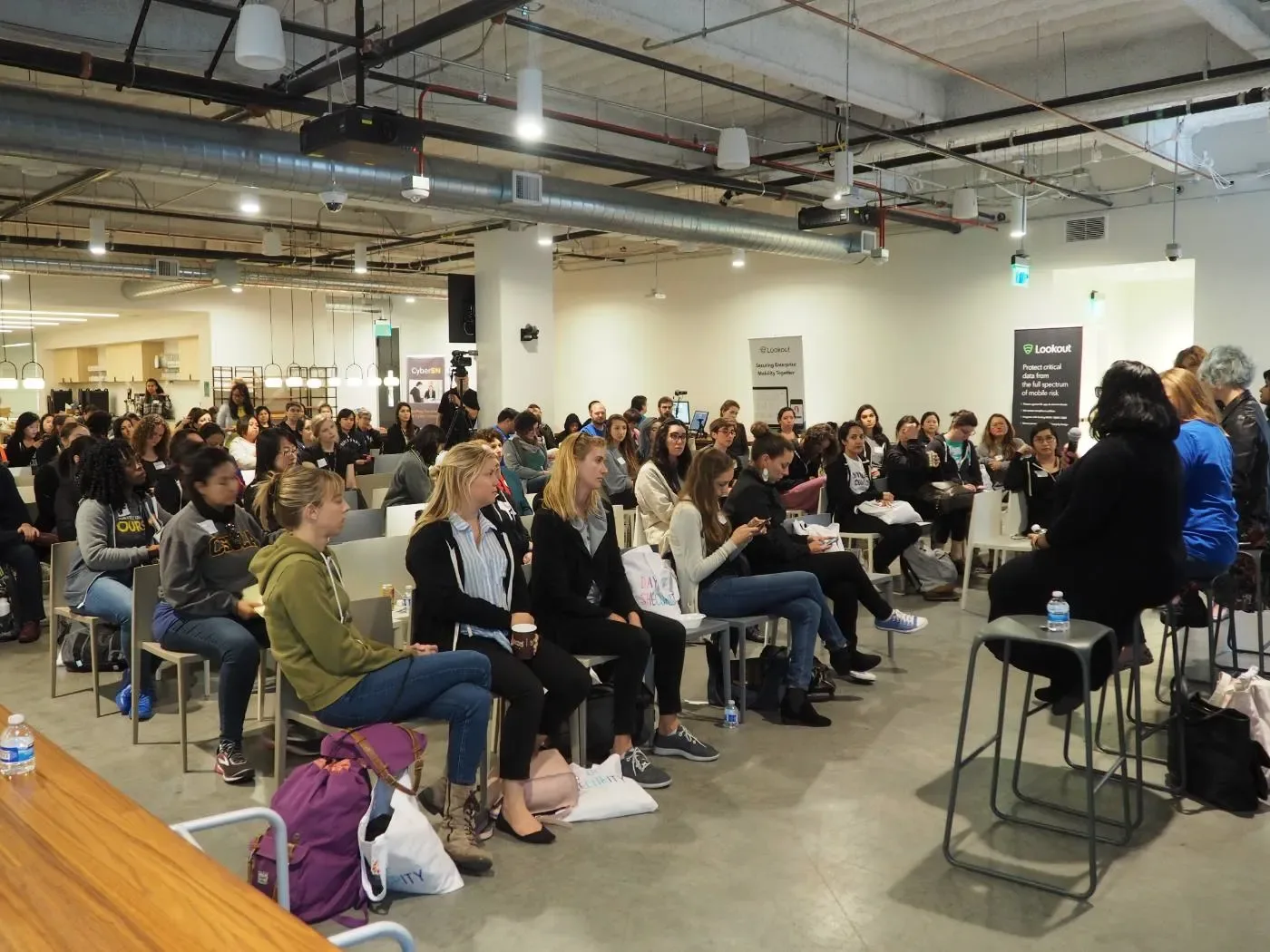
At Day of Shecurity, we have a call for presentations, just like other professional conferences. Women submit proposals to share their subject matter expertise, technical knowledge, innovations, research, strategies, and practical experiences.
Our programs cover cybersecurity disciplines, including security engineering, threat detection, incident response, offensive security, governance, risk, artificial intelligence, and leadership. We have technical presentations, workshops, research discussions, panels, and opportunities to exchange ideas and explore innovations.
These are women presenting what they know and what they're accomplishing.
You hear from women who are founders and chief information security officers, alongside researchers, engineers, threat hunters, technical specialists, and practitioners who are exceptional at what they do, whether they hold leadership titles or not. Every speaker is accomplished in her field and has valuable expertise to share.
And there's something particularly powerful about the environment.
Women aren't encountering just one or two women experts throughout the conference. They're spending an entire day learning from women across cybersecurity disciplines and career levels.
They see women presenting original research, explaining sophisticated technical solutions, introducing innovations, making decisions, challenging ideas, and demonstrating mastery of their work.
For attendees, gender is one potential point of connection. Different professional backgrounds, experiences, and personal characteristics create many more opportunities to identify with a speaker.
This is exactly where the research on role models becomes relevant. The opportunity to see accomplished people we identify with sharing their expertise can influence how we view our own capabilities and possibilities.
And this opportunity is valuable for men as well.
We can all benefit from observing experts who share our experiences and experts whose experiences differ from our own. That's what makes having more opportunities to learn from a wide range of role models so valuable.
2. The Power of Professional Networks
The second reason women's conferences matter is the importance of professional relationships to career success.
Men and women alike benefit from broad, diverse professional networks. Relationships provide access to information, ideas, mentorship, sponsorship, introductions, business opportunities, and career advancement.
It's one of the most important ways careers develop.
And there's compelling research about the additional value women gain from strong professional connections with other women.
Women with highly connected professional networks and strong inner circles of women had an expected leadership-job placement level 2.5 times greater than women with less connected networks and predominantly male inner circles. That's what researchers found when they examined the professional networks of graduate students pursuing leadership positions, in a 2019 study published in the Proceedings of the National Academy of Sciences.
The study establishes an association, rather than proving that a particular type of networking event causes career advancement.
What's especially interesting is the combination of relationships. The women associated with stronger leadership outcomes had both broad professional networks and close connections with other women who could share experiences, knowledge, and access to additional contacts.
Men and women both benefit from extensive professional networks. And women absolutely benefit from attending industry conferences where most participants are men. Those relationships are essential, too.
Yet there's an additional opportunity created when hundreds of women in the same profession come together.
It's difficult to build a substantial network of women in cybersecurity when you're attending conferences where the overwhelming majority of attendees and speakers are men.
At a women's conference, you can meet many more women in your field, across different disciplines, organizations, and experience levels.
A conversation with a fellow attendee can lead to an introduction. A technical discussion can lead to a collaboration. A relationship with a senior professional can develop into mentorship or career sponsorship.
These connections can extend far beyond the event itself.
Knowledge expands our capabilities. Professional relationships expand our opportunities.
And both are important to career success.
Access Is Part of Creating Opportunity
There's another reality worth discussing: attending professional conferences isn't easy for everyone.
Conferences cost money. Registration, travel, hotels, and time away from work can make participation difficult or impossible.
And women can face additional challenges related to caregiving responsibilities.
62% of mothers working full time report difficulty balancing work and family responsibilities, compared with 47% of fathers working full time, according to a 2026 Pew Research Center survey of working parents.
Time, money, caregiving, and employer support all influence someone's ability to travel and participate in professional events.
These challenges are part of the reason organizations fundraise, secure sponsorships, and provide scholarships to help women attend conferences.
They're also why I've intentionally structured Day of Shecurity to be free to attend, offering both a global digital conference and in-person experiences.
The digital experience makes knowledge and connections accessible to people who can't travel or step away from their responsibilities for several days. The in-person experiences provide additional opportunities for professional relationships and deeper conversations.
It takes funding and substantial effort to make either experience possible, especially when attendance is free. That's precisely why sponsorships and community support are so important.
Access to professional learning and networking shouldn't depend entirely on someone's financial resources, schedule, or ability to travel.
Equality Is About What We Can All Become
I think we need to elevate the conversation about equality.
Too often, discussions about women's advancement become conversations about women versus men. Who has the advantage? Who has suffered more? Who is taking opportunities away from whom?
What are we accomplishing by framing equality as a competition between people who should be working together?
Historically, men have had access to educational, financial, and professional opportunities that women were legally or institutionally denied.
Many of the federal protections that changed those opportunities only arrived in the 1960s and 1970s. Laws prohibiting sex discrimination in employment, education, and access to credit are relatively recent developments in our history.
We've made meaningful progress since then. We haven't yet achieved equal opportunity in practice.
Acknowledging that history isn't about blaming men. It's about recognizing that our systems haven't always provided everyone with the same opportunity to develop their capabilities and pursue their ambitions.
And this isn't only a women's issue.
What kind of society could we create if everyone had greater access to the knowledge, relationships, confidence, and support necessary to reach their potential?
More knowledgeable professionals. More capable leaders. More innovation. More collaboration. People better equipped to solve problems, make decisions, work together, and contribute to their organizations and communities. People with the resources and support to build successful careers while also living healthy, fulfilling, joyful lives.
Equality isn't simply about who gets a seat at the table. It's about creating the conditions for more people to develop the competencies, confidence, relationships, and opportunities to contribute meaningfully.
Equal opportunity expands human potential. And expanding human potential benefits all of us.
So when we see an organization struggling to provide educational opportunities, or hear that a conference dedicated to advancing women can no longer secure the funding to continue, I don't think our response should be to question whether those opportunities deserve to exist.
We should be asking how we can create more of them.
Support the organizations doing this work. Sponsor learning opportunities. Share our expertise. Mentor someone. Introduce people to our networks. Encourage our employers to invest in professional development. Show up for one another.
And when someone creates an opportunity that isn't designed specifically for us, recognize the value it may provide to someone else.
We don't have to compete over opportunities to learn and succeed. We can create more opportunities and expand access to them.
We have far more to gain by helping one another become more knowledgeable, capable, confident, connected, and successful than by questioning why someone else has an opportunity to grow.
That's the society I want to contribute to building, and that's why I remain committed to the Day of Shecurity conference.
Find the organizations doing this work
Communities, conferences, podcasts, and training programs supporting women working in or moving into cybersecurity, gathered in one curated directory.
Explore Resources for Women in Cybersecurity