
At Day of Security's 10-year anniversary, one old image raises a very current question about data, bias, security, and the future we are building.
As Day of Security turns 10, I keep thinking about what Secure Diversity has spent a decade trying to change, and what happens when the past becomes training data for the future.
Then I came across this picture again.
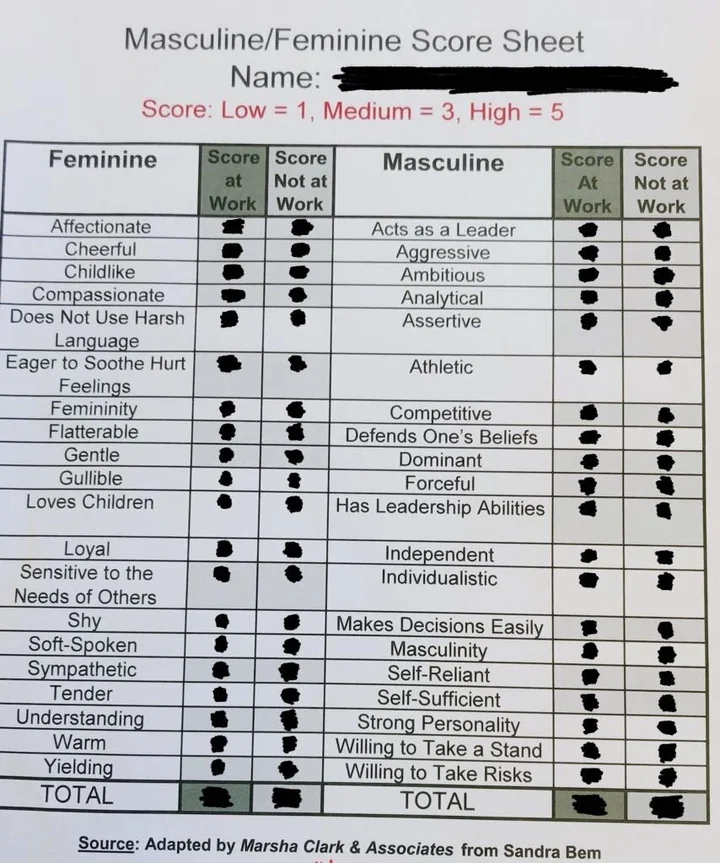
I saved this photo years ago. The worksheet shown here was adapted from Sandra Bem's research first published in 1974 and later appeared in corporate leadership training that became public through HuffPost reporting in 2019.
Look at the words.
Under Feminine:
Affectionate. Childlike. Gentle. Gullible. Shy. Soft-spoken. Yielding.
Under Masculine:
Acts as a leader. Ambitious. Analytical. Assertive. Competitive. Independent. Makes decisions easily. Willing to take risks.
The underlying research dates to 1974.
An adaptation of this framework was still appearing in a corporate leadership program for women in 2018.
Then, in October 2019, HuffPost published the story and images from the training materials online.
That last date matters enormously to me now.
Once material like this is published online, it becomes part of the digital information ecosystem that exists during the development of modern AI.
I cannot tell you that any particular AI model trained on this exact article or this exact image. Unless a model provider discloses its complete training corpus, that would be impossible to claim with confidence.
What we can say is that content like this exists throughout our digital history.
So look at the timeline:
Research categorizes characteristics such as "acts as a leader," "analytical," "assertive," "independent," and "makes decisions easily" as masculine.
An adaptation of that thinking is still appearing in corporate leadership training for women.
The training materials are published online and become part of the public digital information ecosystem.
AI is increasingly influencing workforce decisions, leadership, cybersecurity, business operations, and the way information itself is interpreted.
And now I have a very different question:
What did we train AI to learn from us?
Not only from this one article.
From decades of articles. Decades of job descriptions. Decades of performance reviews. Decades of promotion decisions. Decades of leadership models. Decades of books, research, corporate documents, websites, conversations, and cultural assumptions.
How much of our past did we put into the data before asking AI to help shape our future?
The internet does not forget the world we used to live in
AI arrived after human beings had already spent decades putting our thinking into digital form.
Job descriptions. Performance reviews. Leadership assessments. Books. News stories. Research. Corporate training. Policies. Employee records. Websites. Forums. Databases.
All of it reflects the world in which it was created.
And that world was not equitable.
This picture is striking because you can literally see an old conception of leadership sitting in the data:
Leader = masculine.
Assertive = masculine.
Analytical = masculine.
Makes decisions easily = masculine.
Now imagine how many less obvious versions of those assumptions exist across billions of pieces of information.
That is the part I believe deserves far more attention.
The timing matters
We are having this conversation at an extraordinary moment.
In 2025, the Trump administration moved to terminate federal DEI programs and revoked the long-standing federal-contractor affirmative-action framework established under Executive Order 11246.
At the same time, AI is becoming more influential in decisions about people, work, opportunity, risk, and leadership.
Those two things happening together matter.
Removing intentional diversity efforts does not remove bias from historical data.
The data is still there. The patterns are still there. The history is still there.
And now machines can learn from it at extraordinary scale.
AI does not get a clean slate
AI did not arrive with no history.
It inherited ours.
That should matter deeply to everyone working in cybersecurity, technology, HR, data, legal, leadership, and governance.
When an AI system is trained on historical information, we need to ask:
- What data is it learning from?
- Where did that data come from?
- How old is it?
- Who created it?
- What assumptions are embedded in it?
- Who approved it for use?
- Can we trace its provenance?
- How are we testing the outcomes?
- Who is accountable when those outcomes affect people?
These are not only AI questions.
They are data-security questions.
Security has always included protecting confidentiality, integrity, and access. In the AI era, integrity and provenance become even more important. We need to understand not only whether data is protected, but also whether it is appropriate, trustworthy, current, and fit for the decisions being made from it.
Understanding what is inside your data, who built the systems that use it, and whether the outcomes reflect today's reality rather than yesterday's assumptions is part of what workforce intelligence is designed to surface.
Why this matters to me at Day of Security's 10-year anniversary
Ten years ago, Secure Diversity created Day of Security because access, representation, opportunity, and community in cybersecurity needed to change.
We wanted more people to have access to knowledge. More women to see themselves represented in cybersecurity. More people to get opportunities to speak, teach, lead, learn, and build careers.
For ten years, that work has been about people.
Now it is also about the systems increasingly making decisions about people.
That is why this old picture feels so relevant to me in 2026.
The work is not only about who is in the room anymore.
It is also about what is inside the data.
Who built the systems? Who chose the training data? Who challenged it? Who noticed what was missing? Who recognized that something being historically common does not make it correct?
Diversity in technology is not separate from AI quality or security.
It affects who asks the questions. It affects who recognizes risk. It affects what gets challenged before it gets scaled.
The next ten years
I do not want Day of Security's 10-year anniversary to be only about looking backward at what we have accomplished.
I want it to be about what comes next.
AI will shape the workforce. It will shape cybersecurity. It will shape decisions about people in ways we are only beginning to understand.
That makes one question incredibly important:
Are we using AI to build a better future, or are we teaching machines to recreate our past?
This image began with research from 1974. An adaptation was still being used in 2018. It was published online in 2019. And here we are in 2026, training and deploying AI systems across nearly every part of business and society.
The past does not disappear when we digitize it. It becomes data. And data can become training material.
So as we celebrate ten years of Secure Diversity and Day of Security, I believe our work has another dimension now.
Securing diversity in the age of AI means paying attention to the data shaping the systems that will shape our future.
We need to know our history. We need to know what is in our data. We need people in the room who will question both.
And we need to make sure the future we build with AI is actually more intelligent than the past it learned from.
Sources and references
- Sandra L. Bem, "The Measurement of Psychological Androgyny," Journal of Consulting and Clinical Psychology, 1974
- Emily Peck, "Women At Ernst & Young Instructed On How To Dress, Act Nicely Around Men," HuffPost, October 21, 2019
- White House, "Ending Radical and Wasteful Government DEI Programs and Preferencing," January 20, 2025
- White House, "Ending Illegal Discrimination and Restoring Merit-Based Opportunity," January 21, 2025
- NIST, AI Risk Management Framework
Understand who and what is doing the work
CyberSN's Workforce Intelligence Engagement gives cybersecurity and IT leaders visibility into capabilities, coverage, allocation, and risk across their entire workforce ecosystem, so decisions are based on current data rather than inherited assumptions.
Request a Workforce Intelligence Briefing